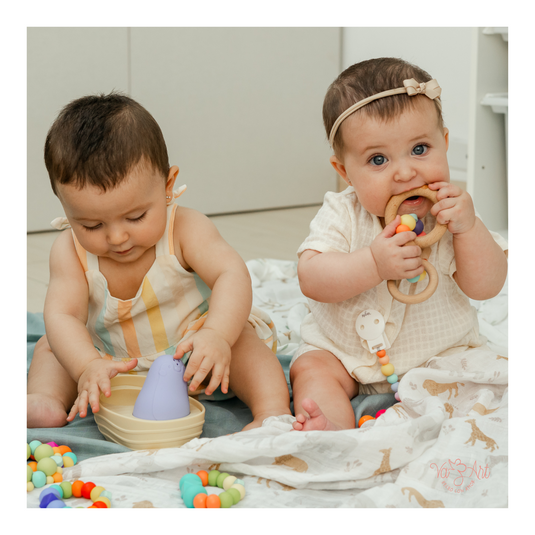
There's no accounting for taste, as we adults say, but our babies, being babies, don't yet have the wide range available to their eyes to marvel at and delight in vibrant colors and radiant textures.
I've always wanted Vazart® to be more than just an online store that sells products and accessories for moms and babies. I feel close to you all, and my best way to return that affection is by telling you about topics that I know interest all of us, so we can discover the world of our children and be better prepared to welcome them and support their development.

Today I want to tell you about the importance of colors in our babies' lives and how their extraordinary vision improves as the months go by. I've also learned this through my work at Vazart®; that's why the concept of a sensory jewel or accessory goes far beyond simple aesthetics. Color plays a fundamental role in each piece, and today, that's what I want to tell you about.
Vision plays a fundamental role in their development
At birth, a baby's visual acuity compared to an adult's barely reaches 5%, as if they are constantly seeing a blurry photograph.
In their first weeks, babies are quite receptive to red. They don't actually identify it as a color, but they can perceive its luminosity.
How their vision evolves
While it's true that when our babies are born, they only see light, shadows, and undefined shapes, it's also true that as the weeks and months go by, their extraordinary vision takes shape and responds to different stimuli. Hence the importance and our commitment to help them in this stage:
As I told you earlier, when our babies are born, they only distinguish between light and shadow and perceive some movements and poorly defined colors.

Objects up to 30 centimeters away are perceived by them, which is why our closeness is essential; it will be the first face they distinguish, don't you find that exciting? I do, even if we are still a nebulous image in shades of gray to them, they will soon recognize us.
At two months, all their color-sensitive eye receptors are fully functional, and they first distinguish red, then green, at three months blue, and later yellow.
At 4 months, our babies can already distinguish most colors. Before 6 months, the outlines of objects with a lot of color catch their attention, and they love those areas where the color changes.
Between 6 months and one year of age, they will have developed an awareness of the existence of colors and will also be able to recognize primary colors, due to the expansion of their visual perception which allows them to distinguish a wide range of these.
When our children reach preschool, there is greater color recognition through perception. Educational games reinforce this recognition, and of course, blue and red become their best friends, and they have fun identifying these two colors in everything they see. This process is known as differentiation when they can distinguish them, and of course, association, when they manage to identify them in some objects.
Later, they begin to show their color preferences; you'll notice because they will always try to choose the ones that are most aligned with their personality, and this is of utmost importance in their development as individuals.
Other important aspects of vision
Evidently, one of the most important aspects of a baby's vision has to do with their neuronal construction. This process makes them attracted to vivid colors, which enrich their connections. This is when neurons begin to connect, which is why it is so important to surround them with vivid colors.
Tips to help stimulate their vision
After telling you a little about the wonderful discovery our babies make of the world through their vision, I'd like to offer some tips for finding the perfect balance between the colors your baby should begin to perceive in their own home:
- In their early stages, use bright colors, especially primary ones. Blue, red, and yellow should be included somewhere in the room.
- Spaces that are entirely pink or entirely blue, depending on the baby's gender, are not as recommended. There's no way for neuronal connections to be strengthened that way, which would happen with primary colors. Try to seek variety.
- Pastel colors are recommended as long as you can mix them with primary colors; that way, the baby will be sufficiently stimulated.
- "Neither too much nor too little," overdoing it with bright colors in the baby's room could make them feel overwhelmed. As I mentioned earlier, you can mix with pastel colors.
- Don't overdo red; it can have the opposite effect and be too distracting due to its brightness.
Remember that colors awaken our babies' creativity and imagination, and that the first and best stimulus your child can receive is your face; it will be their favorite visual stimulation for many weeks.
Place mobiles and objects in their room that create light and shadow. They will feel happy and amazed by a new world to discover through their vision. Remember that as their visual perception develops, they will be attracted to vivid and intense colors.
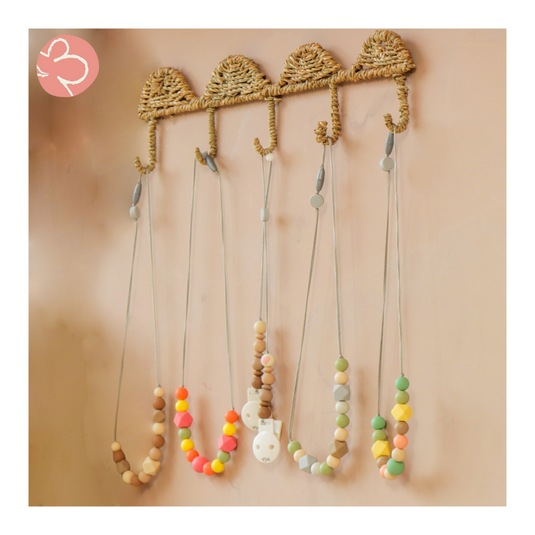
At Vazart® we have wind kites, rattles, mobiles, pacifier clips, and a whole line of sensory accessories that will contribute to their psychomotor development. Visit our website to see them all and indulge in accessories in beautiful colors on our Instagram account.
I hope you enjoyed this blog post as much as I did, and please tell me about your experience during this beautiful stage in your babies' lives. I would love to read your comments.
Warm regards.
Andrea.